Article
What is an estimate? Definition, estimate vs quote, and key parts
An estimate is a non binding price guide sent before work starts. Learn how it differs from a quote, what to include, and how it becomes an invoice.
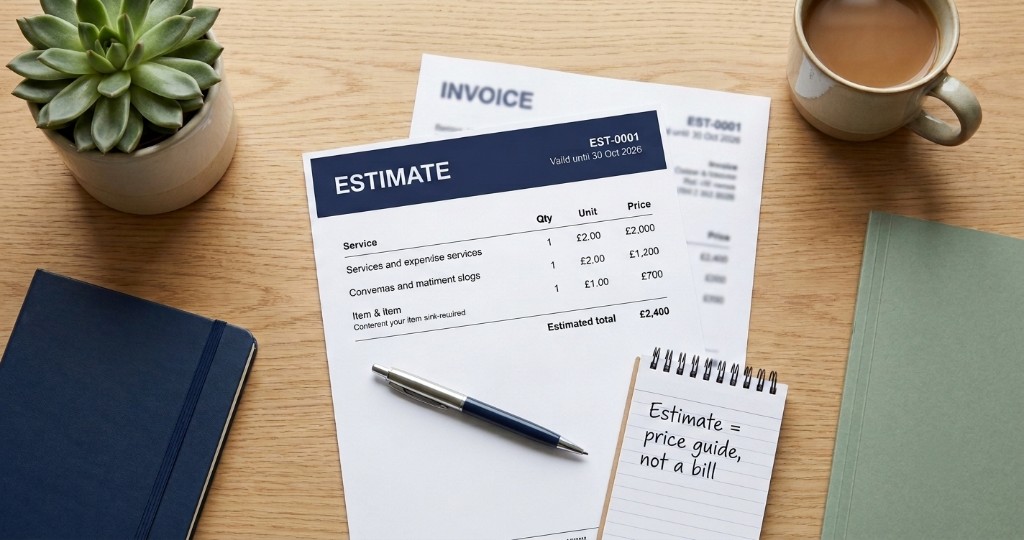
Short answer: an estimate tells a client what a job will cost before any work starts. It sets out the scope, the price and how long the offer stands, and it isn’t binding, so the client can question it, change it or say yes.
An estimate is a document that gives a client an idea of how much a job will cost before any work begins or any money is due. It includes the scope of the work, the price or price range and the time the estimate stays valid. It is not a binding agreement. The client can discuss, change or accept the estimate.
Think of it as a conversation on paper. You’re saying “here’s what I think this will take and what it’ll cost,” and giving the client something concrete to react to before either of you commits.
An invoice comes later, once the price is agreed and money is due. It’s a formal request for payment. Mix the two up and the client’s finance team won’t know whether they’re meant to negotiate or pay. For more on that definition, see what is an invoice. For the side by side decision, see invoice vs estimate.
Why estimates matter for freelancers
They set expectations early
A clear estimate eliminates “we thought that was included” arguments later and gives you a written record of what was discussed. It also filters out clients unwilling to pay according to your efforts and worth, before you spend any money and time on someone’s work.
They protect your numbers
When you convert an approved estimate into an invoice, the line items, tax, and discounts carry over as they are. Retyping the same numbers manually can lead to errors and may hurt the business if such an error prone invoice is sent.
Estimate vs quote vs proposal
In everyday conversation, plenty of people use “estimate” and “quote” as if they mean the same thing. They don’t, and the difference matters more than it looks.
| Term | What it means | Binding? | When freelancers use it |
|---|---|---|---|
| Estimate | An approximate price or range, based on what you know so far | Generally no | Early conversations, fuzzy scope |
| Quote | A fixed price for a clearly defined scope | Can be, once accepted | Clear, bounded deliverables |
| Proposal | A longer pitch covering approach, timeline, and pricing | Depends on the terms | Larger or competitive pitches |
The key point: a quote is a firm offer. In the UK, US, Australia, and many other places, an accepted quote can form part of a binding agreement, so you may have to abide by that price. An estimate is a guide, and it’s understood that the final price can move.
If you’re not completely sure about the price you are requesting and want a little flexibility, call the document an estimate and mention that the price may change. Our take: send an estimate while you’re still working out the scope, then a fixed quote once the scope is clear. Most clients prefer to have certainty regarding the cost of work so as to budget accordingly and not be surprised by sudden price fluctuations. Moreover, you’re less likely to be caught out by any extra work you didn’t price in.
When to send an estimate
Send one when the project is still fuzzy, the client has asked for a ballpark, you need something in writing before you start, or the price and deliverables might still move.
You can skip straight to an invoice when price and scope are already agreed in writing, or when you’re billing a recurring retainer with fixed terms. There’s no point dressing up a payment request as a proposal.
What a strong estimate includes
The essentials
- The word “Estimate” at the top, so nobody mistakes it for a quote or an invoice
- An estimate number and date (EST-0001, EST-0002, kept separate from your invoice numbers)
- Your name, business details, and contact information
- The client’s name and company
- A clear scope and list of deliverables
- Line items with quantities, hours, or rates, plus tax where it applies
- The price, as a fixed figure or a range
- A validity window, for example “valid for 14 days”
Worth adding
- Assumptions: what your numbers are based on, such as “two rounds of revisions” or “content supplied by the client”
- Exclusions: what isn’t covered, like rush fees, extra revisions, or third party costs
- Timeline: a rough start date and delivery window
- Deposit and payment terms that will apply once they approve
- A change order note explaining how extra work gets priced and approved
- Options: a basic, standard, and premium version, so the client picks a level instead of just saying yes or no
- How to accept: a signature line, an e-sign link, or a simple “reply to confirm”
Lines you can copy
This estimate is valid for 14 days from the date above. It’s based on the scope and assumptions listed, and the final price may change if the scope changes.
To approve, reply to this email or sign below. Any additional work will be quoted separately before it starts.
Worked example: freelance consultant estimate
| Field | Example |
|---|---|
| Estimate number | EST-0021 |
| Client | Northbridge Ops Ltd |
| Scope | Process mapping workshop + summary deck |
| Price | £1,800 fixed (includes 1 revision round) |
| Assumes | Up to six stakeholders, one half day workshop |
| Excludes | Implementation work, travel outside Greater London |
| Valid until | 20 September 2026 |
| Next step if approved | 40% deposit invoice, then scheduling |
Because the price here is fixed, this document is really working as a quote, and that’s fine. Many freelancers keep the label “estimate” but make the fixed price and the assumptions very clear. When Northbridge says yes, the consultant converts EST-0021 into a deposit invoice instead of rebuilding the lines by hand.
How estimates become invoices
The clean path
- Send the estimate
- The client approves in writing (email is fine for many freelancers)
- Convert it to an invoice for the deposit, milestone, or full amount
- Keep your branding consistent so finance recognises both documents
In invoice apps like Trueinvoice you can create an estimate and convert it without retyping anything.
Scope changes after approval
If the client adds work, revise the estimate (or send a change order) and get approval again before you invoice the new amount. Quietly adding lines after they’ve said yes is a fast way to lose trust.
Hourly estimate ranges
Not every job fits a single fixed fee. When discovery is fuzzy, an hourly range keeps the conversation honest without pretending you know the exact total.
How to present a range
State the rate, the expected hour band, and what would push the job to the top of it:
Estimated advisory time: 12 to 18 hours at £120 per hour (about £1,440 to £2,160). The higher end applies if stakeholder interviews expand beyond six people or if two workshop sessions are required instead of one.
Keeping a range from running away
- A not to exceed cap if the client needs budget certainty
- A check in at a fixed hour count before you carry on
- Clear exclusions, so a “range” doesn’t turn into unlimited work
- Switching to a fixed fee once the scope firms up
When ranges backfire
A range with no rate, no assumptions, and no cap just reads as vague. Clients remember the low number; you remember the high one. Put both ends in writing and say what moves the price between them. After approval, invoice deposits or hours against that estimate rather than inventing a new figure.
Revising expired estimates
Estimates should expire. Once the validity window passes, don’t let a client treat last month’s PDF as live pricing forever.
What to do when an estimate expires
- Mark it as expired in your system or notes
- If the client comes back, review the scope, your rates, and your availability
- Issue a revised estimate with a new number (or a clear revision label) and a fresh validity window
- Point out anything that’s changed in the email (“rate updated; timeline moved to November”)
If they approve after expiry without asking
Either confirm in writing that you’ll honour the old terms, or send the revised estimate before you start. Your costs and calendar may have changed since, and it’s much easier to sort that out now than halfway through the job.
Partial approvals
Sometimes a client likes half the scope. Split or revise the estimate so the approved part is explicit, then invoice only that part. A half negotiated PDF as your only record makes the conversion to an invoice messy.
Common estimate mistakes
- Vague scope (“website work”) with no deliverables
- No validity window
- No assumptions, so the client can’t see why the price might change
- Calling it a quote when you actually want flexibility on price
- Mixing estimate language with a due date and a payment demand
- Forgetting exclusions
- Never converting, and retyping the invoice from memory
Where to go next
FAQ
What is the difference between an estimate and a quote?
People often use the two words interchangeably, but they mean different things. An estimate is an approximate price for the work, and it can change. You’d usually send one when the full scope isn’t clear yet. A quote is a fixed price for a clearly defined scope, and once the client accepts it, it can become a binding agreement. In short, an estimate is flexible and a quote is firm.
Is an estimate legally binding?
Generally no, as long as it’s clearly labelled as an estimate and says the price may change. A quote is different: once it’s accepted, it can become part of a binding agreement. Check local practice with an advisor if the stakes are high.
How long should an estimate stay valid?
Common windows are 14 or 30 days. Print the expiry date so the client knows when pricing may change.
When do I turn an estimate into an invoice?
As soon as the client approves and payment is owed (deposit, milestone, or final delivery). Converting keeps line items accurate.