Article
What is a recurring invoice? How retainers and subscriptions work
Defining recurring invoices, when freelancers should use them for retainers or subscriptions, and how scheduled billing protects cash flow.
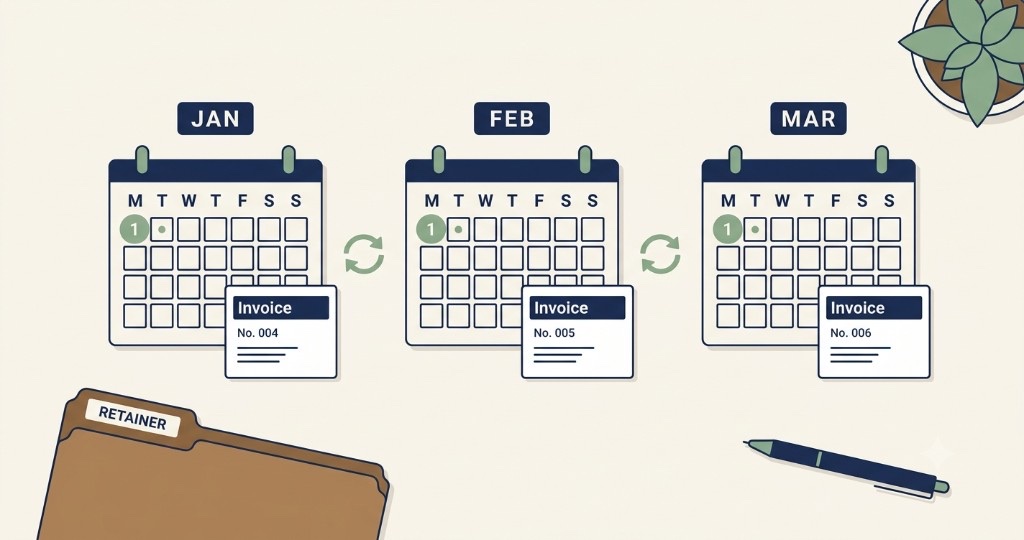
Short answer: a recurring invoice is the same bill sent on a schedule, which makes it ideal for retainers and subscriptions. Each cycle still gets its own number and date, and you’ll want a plan for when a card payment fails.
A recurring invoice is simply an invoice or a bill that repeats on a schedule with the same or a predictable structure. Freelancers reach for them on retainers, subscriptions, and any repeat work, mostly so that they are not rebuilding the exact same document from scratch every single month. It is a small piece of automation that removes one of the most forgettable admin tasks you own.
This is the plain definition. For how retainers fit into your weekly money rhythm, see cash flow habits for freelancers. Using an invoice app like Trueinvoice you can set up a recurring invoice.
Why recurring invoices exist
The main objective of setting up a recurring invoice is to create an income floor. Plan, review, and then agree on the retainer once. Set up a recurring invoice with the base structure to be sent monthly, weekly, yearly, etc. The rest is handled automatically, and now you not only have predictable work and steady income but also you can focus on other important stuff rather than creating invoices each time you complete the work. Project work stops being your entire income and becomes the upside sitting on top of something steady.
The second benefit is that they remove skipped months. Improvising a fresh invoice every month is exactly the kind of task that slips when you are busy, and the result is a forgotten bill or an awkward “sorry, here are two months at once” catch up. A schedule simply deletes that failure mode.
Recurring invoice vs retainer vs subscription
These three get used interchangeably, but they are not the same thing, and the distinction saves you confusion later:
| Term | Meaning |
|---|---|
| Retainer | Commercial agreement for ongoing work at a set fee |
| Subscription | Client pays for ongoing access or a packaged service |
| Recurring invoice | The scheduled billing document that collects the fee |
You can absolutely have a retainer without any software (manual monthly invoices work). Recurring invoicing is just the habit and the tool that make that retainer reliable instead of dependent on your memory.
When freelancers should use recurring invoices
Reach for them when:
- A client pays monthly for ongoing work
- Scope is stable enough to reuse the line items
- You want billing to land on a fixed calendar day
When not to force them
Skip the recurring schedule for one off projects, for highly variable hourly work with no retainer behind it, and for jobs that genuinely need a fresh estimate each time. Automating something that changes every month just moves the effort into fixing the automation.
Bill in advance or in arrears?
In advance means you invoice before (or at the start of) the service period. April’s retainer goes out in late March or on 1 April, and you expect payment before you are deep into the month. That is the usual pattern for capacity retainers and subscriptions: the client is reserving your time, so they pay to reserve it.
In arrears means you invoice after the period closes, once the work is done. That can fit usage heavy or highly variable months, but it puts cash flow back on project style timing.
For most freelancers, advance billing is the point of a retainer. Pair it with shorter payment terms. On a monthly cycle, Due on Receipt or Net 7 (sometimes Net 14) fits far better than Net 30. Net 30 on a monthly retainer means each invoice is barely paid before the next one goes out, and one late payment leaves you carrying two months at once. Full term definitions live in payment terms on invoices.
How the money gets collected
A recurring schedule can either:
- Send the invoice on the issue day and wait for bank transfer, cash, or any other payment method used
- Auto charge a saved card (where your gateway supports it) so the invoice is created and paid in one motion
Send only is simpler to start and works when clients prefer bank transfer. Auto charge reduces chase work on subscriptions and retainers, but you still need a failed payment plan when cards expire or decline (see below). In Trueinvoice, connecting Stripe adds pay button on the document making it easier for the clients to pay its setup is in Connect Stripe and get paid.
Annual vs monthly schedules
Most retainers run monthly, and that’s usually the right call. But some clients would rather pay once a year, and that changes a few things.
Monthly
Best for ongoing projects, retainers, and SaaS style service packages. The money comes in monthly, you have a chance to evaluate the scope quarterly, and any skipped month gets noticed quickly rather than being allowed to fester. Use a fixed issue day (the 1st, say) so the client can predict the bill and budget for it.
Annual (or multi month)
Software licences often work this way, and so do big companies whose procurement team will only raise one purchase order a year. Getting a year’s money up front is lovely for planning. The catch is that it all rides on one invoice, so if that client pays late or argues about something in June, the whole year’s income is stuck. A few things worth doing:
- Invoice annual fees a few weeks before the period starts
- Write the exact dates it covers, like “1 Jan 2026 to 31 Dec 2026”, so nobody argues about when it ends
- Decide whether a mid year exit needs a credit note or an unused months refund policy
Choosing between them
If cash flow is tight, prefer monthly, no contest. If the client’s procurement only renews yearly, annual might be the only path open to you, so protect yourself with clear renewal dates and written scope. Quarterly sits in the middle and suits some coaches and agencies. In rare cases you can set a weekly or a custom schedule as well.
Proration basics
If a retainer starts on the 16th, should the client pay for the whole month? Probably not. Charging only for the part they actually get is called proration.
Simple approach
If a £2,000 monthly retainer starts on the 16th of a 30 day month, plenty of freelancers bill half (£1,000) for that first partial month, then the full amount from the next full cycle. Whatever rule you pick, agree it in writing:
Partial months are billed proportionally by calendar days unless we agree a flat kickoff fee instead.
What to avoid
Pick one rule and stick to it. Working out a new method each time looks sloppy, and billing a full month for two days’ work will annoy most clients unless your agreement sets a minimum. Think about the end too. When a retainer finishes, decide early whether the last month is charged in full, by the day, or through a notice period fee, and make the final invoice match.
After proration
Update the recurring template so the next full cycle uses the standard amount, and leave a short note on the first invoice saying it was prorated. Otherwise a finance team may reasonably assume every month will be that smaller partial figure.
Failed payment recovery
Card pulls and some bank payments fail: expired cards, insufficient funds, blocked transactions. Recurring billing needs a plan for that, because “the schedule handles it” stops being true the moment a payment bounces.
Immediate steps
- Note the failure date and the reason, if your payment tool provides one
- Let the client know, once and without fuss, and include the invoice number and a new pay link
- Leave the invoice as unpaid or partly paid. Don’t mark it paid just because you’re expecting the money
- Retry per your tool’s rules, or ask for a new card or a bank transfer
If failures repeat
Pause the recurring schedule until the payment method is fixed, so you are not piling up all your failed attempts. If cards keep bouncing, move that client to bank transfer, and run your normal reminder cadence on the open invoice. See how to set up and send payment reminders.
Do not ignore “paid” false positives
If a payment shows as pending and then fails, reconcile it against your bank or the connected third party payment gateway dashboard before you release any more work. This is exactly why careful recording matters: how to record a payment.
What to put on a recurring invoice
Keep these consistent
- Client identity
- Core line items and rates
- Payment terms and methods
- Branding
Still unique each cycle
- Invoice number (new each time)
- Invoice date
- Calendar due date
- Period covered (“September 2026 retainer”)
Copy paste period line
Monthly retainer for content support: 1 September 2026 to 30 September 2026.
Worked example
Sam has a £2,000 monthly marketing retainer, and here is the whole flow:
- Agree the scope once, billed in advance, with Net 7 or Due on Receipt
- Set a recurring invoice for the 1st of each month
- Each cycle issues INV 0201, INV 0202, and so on, with the September or October period in the description
- The client pays by bank transfer or the card Pay button (or auto charge if a card is on file)
Come Friday, Sam’s cash flow review just checks that next month’s recurring bill is queued, instead of that familiar sinking “wait, did I actually invoice them?” feeling.
Deposits, pauses, and changes
Scope or price changes
Tell the client, update the recurring template, and confirm before the next issue date. Surprises on a recurring bill erode trust faster on a retainer than anywhere else, because the client expected it to be predictable.
Pausing work
Pause the schedule whenever a retainer goes on hold, so you are not firing off a surprise bill for work that is not happening.
Collections still matter
Recurring does not mean “always paid”. Use the same reminder habits you would on any other invoice. See get paid faster and how to set up and send payment reminders.
Where to go next
FAQ
What is a recurring invoice?
It’s a bill that goes out on a schedule, say every month or every year, with the same or very similar lines each time. Freelancers mostly use them for retainers and subscriptions.
How is a recurring invoice different from a retainer?
A retainer is the commercial agreement (ongoing monthly work for a fee). The recurring invoice is just how you get paid for it: the same bill going out on the same day each cycle.
Can I change a recurring invoice later?
Yes. If the scope or price changes, edit the schedule or the line items, but give the client a heads up before the next one goes out.
Do recurring invoices still need due dates?
Yes. Each generated invoice should still show a calendar due date and payment methods.
Should I bill retainers in advance?
Usually yes. Bill before the service period starts so you are not financing a full month of work. Due on Receipt or Net 7 fits monthly retainers better than Net 30.