Article
Freelancer tax basics: invoices, expenses and what to set aside
How invoices and expenses feed your tax return, how much to set aside, which records to keep, and key dates for UK, US, Australian and Canadian freelancers.
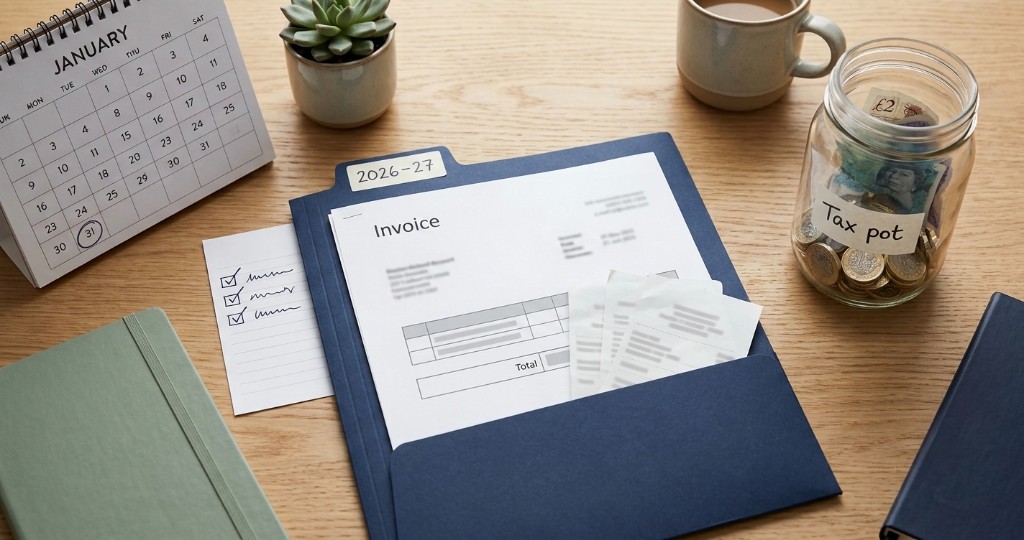
Short answer: tax is charged on your profit, which is what you earned minus your business costs. So if your invoices and expenses are tidy, you’ve already done most of the work. Move 25 to 30% of every payment into a separate tax pot the day it lands, keep your records for as long as your country asks, and get an accountant involved once things stop being simple.
Most freelancers don’t dread tax because it’s hard. They dread it because they leave it until January and then try to rebuild twelve months from bank statements and half remembered receipts. Do a little as you go and tax filing becomes an afternoon of adding up, not a week of detective work.
A quick note before we start: this is general guidance, not advice for your specific situation. Tax rules change, and they’re different in every country. Check the official source for wherever you file, or ask an accountant. For the day to day habits, read how to track expenses as a freelancer and cash flow habits for freelancers.
How your invoices feed your tax return
Your income figure has to come from somewhere, and invoices are where it starts. Each one shows who you billed, how much, and on what date. Add the payments you’ve recorded against them and you’ve got the evidence behind the number on your return.
That’s why the “just send it to my account” jobs cause trouble later. A bank transfer with no invoice behind it is hard to explain if a tax office asks, and easy to forget when you’re adding up the year. Even for small one off jobs, send a proper invoice with a number. If you’re not sure what that needs to include, what is an invoice covers the essentials. If you ever void one, keep it and issue a new number rather than editing the old one, as covered in invoice numbering.
Invoice date or payment date?
These are two different dates, and it matters which one your tax system uses. Some freelancers report income when they invoice it (sometimes called the accruals basis). Others report it when the money lands (the cash basis). In the UK, most sole traders now use the cash basis by default. In the US, most self employed people use the cash method too.
Easiest answer: keep both. The invoice already has its date on it. When the money turns up, record the payment on the day it arrived, and if a client splits it across two transfers, log both against that one invoice. Come year end, whichever date your accountant asks for, you’ll have it.
How your expenses reduce the bill
Legitimate business costs come off your profit before tax is worked out. Software, equipment, travel to clients, marketing, professional fees and a share of home office costs are the usual suspects, though what counts varies by country.
The catch is proof. “I’m sure I spent about £600 on software” won’t hold up. A receipt, a category and a date will. That’s why expense tracking and tax are really the same habit. In Trueinvoice you can snap the receipt and log the expense in one go; see track expenses and receipts.
How much to set aside
Here’s the rule of thumb most freelancers start with: when a client pays you, move 25 to 30% of it into a separate savings account that same day, before you’ve had a chance to spend it. Treat that number as a first guess. Your real rate depends on how much profit you make, your country’s tax bands, and whether there are social security contributions on top. Once your first proper tax bill arrives, you’ll know whether to nudge it up or down.
VAT or GST works differently. The tax you add to a client’s invoice was never your income. You’re just holding it until it’s due, so set aside all of it, not a percentage.
Key dates and rules in a few countries
Every country runs its own system, and it’s worth knowing the handful of dates and numbers that apply to you. Here are four common ones side by side. These figures were correct when we checked in September 2026, but they do change, so confirm them on the official site before you rely on them.
| Country | Tax year | Main deadlines | VAT or GST registration | Keep records for |
|---|---|---|---|---|
| UK | 6 April to 5 April | Return and balance by 31 January; payments on account on 31 January and 31 July | Over £90,000 turnover in any rolling 12 months | 5 years after the 31 January deadline |
| US | Calendar year | Estimated tax around 15 April, 15 June, 15 September and 15 January | No federal VAT; sales tax rules vary by state | Usually 3 years from filing |
| Australia | 1 July to 30 June | Return by 31 October if you lodge yourself, later through a registered tax agent | A$75,000 turnover | 5 years |
| Canada | Calendar year | Return by 15 June if self employed, but any balance owed is due 30 April | Over C$30,000 in four consecutive quarters | 6 years |
Two things in there catch people out. In the UK, payments on account mean your second year can feel brutal, because you pay the first year’s bill and half of the next one in advance at the same time. And from April 2026, UK sole traders earning over £50,000 have to use Making Tax Digital for Income Tax, which means sending HMRC a short update every quarter through recognised software. That threshold falls to £30,000 in April 2027 and £20,000 in April 2028, so plenty more freelancers will be pulled in soon.
In the US, the surprise is usually self employment tax. It’s 15.3% of your net earnings, covering Social Security and Medicare, and it comes on top of income tax. That’s a big part of why 25 to 30% is a sensible starting point.
If you use Trueinvoice, set your financial year start month in Settings to match your tax year, April for the UK or July for Australia, and your Reports will line up with what you file. See read reports and analytics.
Which records to keep
Think about what you’d need if a tax office wrote to you asking about a year from three years ago. You’d want the invoices you sent, proof of what was paid and when, the receipts behind your expenses, and bank statements that tie it all together. A note explaining anything odd, like why INV-0118 was voided or why a client got a refund, saves a lot of head scratching later.
Digital copies are fine in most places, as long as they’re complete and readable. A folder for each year with your invoices and receipts inside is plenty. A camera roll with 400 unlabelled photos is not.
A routine that keeps it manageable
None of this needs a big monthly admin session. It works best in small, regular chunks.
On a Friday afternoon, take ten minutes. Send any invoices for work you finished that week, log what you spent, and move your tax percentage out of anything that got paid. That’s it.
Once a month, spend another twenty minutes seeing which invoices are still unpaid, cancelling any subscriptions you’ve stopped using, and comparing what came in with what went out.
Every quarter, block out an hour. Match your invoices against what actually landed in the bank, hunt down any missing receipts while you can still find them, and check that your tax pot looks about right. If you’re in Making Tax Digital, your quarterly update is due around now anyway, so you’re killing two birds at once.
Then, a few weeks before your deadline, pull the year together and send your accountant a short list of questions. Early, not the week before.
What a tidy year looks like
Take Lea, a freelance designer in Bristol. In the first quarter she invoices two monthly retainer clients and three one off projects, logs her software subscriptions and a new laptop, and moves 28% of every payment into a separate savings account.
In the second quarter, one client pays an invoice in two transfers, so Lea records both payments against the same invoice. She spots a mistake on another invoice, voids it, and issues a new one with the next number instead of editing the PDF. In July, she realises she never saved the receipt for a £180 conference ticket. A quick search of her inbox turns up the booking email, and it goes in the folder.
January arrives and there’s nothing to reconstruct. Her accountant gets a tidy summary and three questions, and her tax pot covers the bill with a little left over. None of it needed fancy software. It needed the same small habits, every week.
Mistakes that make tax time painful
The biggest one is spending the tax pot. It’s tempting in a quiet month, but it leaves you with a bill and no money to pay it. Close behind are taking payments with no invoice, photographing receipts without recording what they were for, mixing personal and business spending on one card, and leaving everything until the last fortnight before the deadline. Some of these start on the invoice itself, which is why common invoice mistakes is worth a read too.
When to bring in an accountant
Good habits get you a long way, but an accountant is worth it when things get more complex. Bring one in when:
- you’re getting close to the VAT or GST registration threshold
- you’re hiring subcontractors or thinking about setting up a company
- you work with clients abroad or get paid in several currencies
- you’re unsure what you’re allowed to claim
- you’ve had a letter from the tax office you don’t understand
Turn up with organised records rather than a shoebox and you’ll spend less on their time. Your job is to keep the records. Their job is to turn them into a correct return.
Where to go next
FAQ
Do freelancers need invoices for tax?
Not always by law, but you’ll struggle without them. An invoice is the simplest proof of what you earned and when. And once you’re registered for VAT or GST, you generally have to issue proper invoices anyway.
How much should a freelancer set aside for tax?
Most people start with 25 to 30% of each payment and fine tune it after their first real tax bill. VAT or GST is separate. That money was never yours, so put all of it aside.
Are business expenses tax deductible for freelancers?
Usually, if the cost was purely for your business. Software, equipment, travel to clients, and professional fees are common examples. What qualifies varies by country, so keep the receipts and check with an accountant if you’re unsure.
How long should freelancers keep tax records?
Longer than most people think. Five years after the 31 January deadline in the UK, five years in Australia, six in Canada, and usually three years from filing in the US. If in doubt, keep them.
When should a freelancer hire an accountant?
Once you’d rather pay someone than worry. For most freelancers that’s when VAT or GST registration gets close, when they start hiring help or billing clients abroad, or when a letter arrives from the tax office. A good accountant often saves more than they cost.