Article
How to number invoices: formats, examples, and rules
How to number invoices with a simple sequential format, examples freelancers use, what tax rules expect, and the mistakes that cause payment delays.
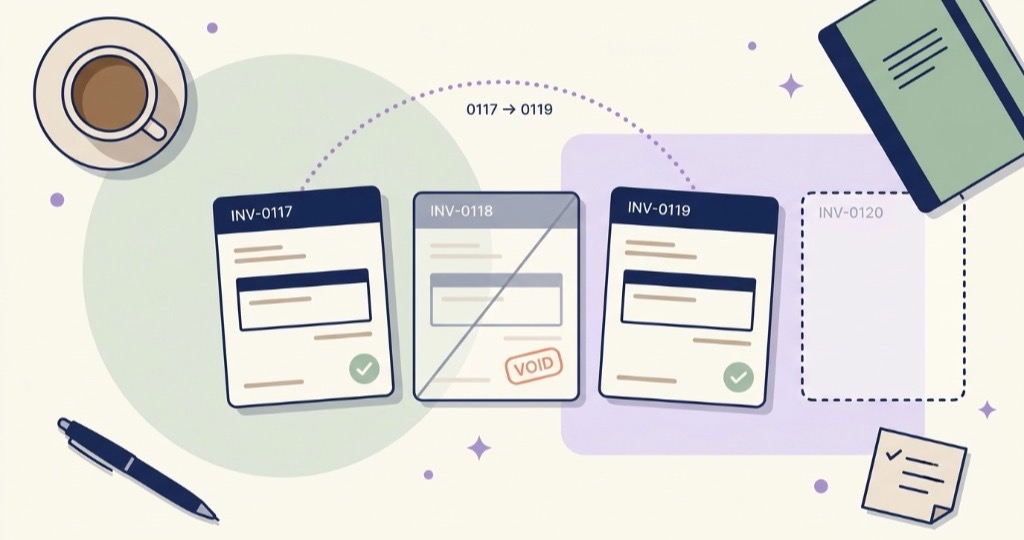
Short answer: give every invoice a unique ID which increases sequentially, such as INV-0001, INV-0002, INV-0003. Keep the format for invoices consistent. If you void an invoice keep a record of the voided invoice so the gap in the invoice numbering makes sense.
An invoice number is a unique ID for each bill you send. Your clients use it to match payments to the right invoice, and you use it to find records at tax time. Without a clear system, you end up with duplicates, gaps you can’t explain, and finance teams emailing to ask which PDF is the real one.
This guide covers simple formats that work for freelancers, and what tax rules expect from your invoice numbers. For the full invoice build, see how to make an invoice. For how numbers look to payers, see what makes a professional invoice.
Why invoice numbering matters
For your client
Accounts payable uses the invoice number to record the bill, match the payment to it, and avoid paying the same invoice twice. If two PDFs share the same number, the accounts payable team has to stop and look into it, and your payment stalls until it’s sorted out.
For you
Unique numbers make searching, reporting, and sorting out disputes possible. Reused numbers tend to cause trouble at exactly the wrong moment, usually when a client is disputing a payment or your accountant is closing the year.
The rules to follow
Whatever format you pick, these five rules keep you out of trouble:
- Unique: no two invoices ever share a number, including across clients and currencies
- Sequential: each new invoice takes the next number in the series
- Consistent: same prefix and same number of digits every time (INV-0014, not INV-14 one month and INV-014 the next)
- Never reused: a voided or cancelled number stays voided
- Explainable gaps: if a number is missing, you can point to the voided invoice or a note saying why
What tax rules say
Rules vary by country, but they point in the same direction:
- UK: HMRC requires VAT invoices to carry “a sequential number based on one or more series which uniquely identifies the document.” Letters are allowed, you can run more than one series if needed, and gaps are acceptable if you keep the cancelled invoice or can explain the break in the sequence.
- EU: the VAT Directive also requires a sequential number that uniquely identifies each invoice.
- US: the IRS doesn’t set a numbering format, but unique, traceable numbers are expected if your records are ever reviewed.
This is educational, not tax advice. Check the current rules where you’re registered, especially if you’re VAT or GST registered.
Invoice number format examples
| Format | Example | Good when |
|---|---|---|
| Plain sequence | INV-0001, INV-0002 | Solo freelancers starting out |
| Year prefix | INV-2026-0014 | You want to see the year at a glance and file by year |
| Client code + sequence | ACME-0012 | Heavy repeat billing for a few clients |
| Year and month | INV-202609-014 | High volume, filed monthly |
Our recommendation
Start with INV-0001 and count up by one. Add a year prefix only if you start sending a lot more invoices or your accountant asks for it. Four digits covers up to 9,999 invoices, which is plenty for most freelancers for many years.
Starting at a number other than 1
You don’t have to start at 1. Plenty of freelancers start at INV-1001 so a new client’s first invoice doesn’t read as “number one.” HMRC explicitly allows this, as long as the numbers run in sequence from wherever you start.
A rule you can copy
Every new invoice gets the next unused number. Voided invoices keep their number and are never reused for a different bill.
Where the invoice number should appear
The number only helps if people can see it:
- At the top of the invoice, next to the invoice date
- In the email subject line (“Invoice INV-0042 from Brightline Studio”)
- In the PDF filename, such as
INV-0042-Brightline.pdf - As the payment reference, by asking the client to quote it on their bank transfer
That last one is what lets you match a payment to the right invoice without chasing anyone.
Common numbering mistakes
- Restarting at INV-0001 every month or year without the date in the number
- Reusing a number after a client paid the first version
- Skipping numbers randomly without a void record
- Putting the estimate number on the invoice instead of giving it its own invoice number
- Hand editing numbers in Word copies until two files conflict
- Using spaces inside the number, which can get mangled in bank references and searches
Estimates vs invoices
Estimates should have their own sequence (EST-0001, EST-0002), so nobody confuses a proposal with a payment request. When you convert an estimate, the new invoice gets the next invoice number. See what is an estimate and invoice vs estimate.
Worked example
Jordan’s last invoice was INV-0117. This week:
- He voids INV-0118, which went to the wrong client before anyone paid it
- He issues INV-0119 to the correct client
- He never recycles 0118 for someone else
Jordan’s records still make sense: 0118 exists as voided, and 0119 is the live bill. If his accountant asks about the gap, the answer is right there.
Numbering across currencies
If you bill in more than one currency, you still need unique invoice numbers across all your bills, not an INV-0001 for pounds and another INV-0001 for dollars. Finance systems, and your own search, will trip over the duplicates.
Ways to handle it
- One global sequence for all currencies (INV-0201 in GBP, INV-0202 in USD)
- A currency prefix only if your accountant prefers it (INV-GBP-0201), still unique overall
- Always print the currency symbol or code on the total, so the number isn’t doing two jobs
Don’t restart numbering when you add a currency, and don’t reuse a number because “it was a different currency, so it’s fine.” It isn’t fine.
Credit notes vs new numbers
When you need to reverse or reduce a sent invoice, pick one method and stick to it.
Credit note
Issue a credit note that references the original invoice number and the amount being credited. The original number stays in your history, and your next new invoice still takes the next unused number. This works well when the client has already booked the original bill into their system.
New invoice
Void or cancel the original (keeping its number as voided), then issue a corrected invoice with a new number. Tell the client which document to pay, and never quietly swap out the PDF under the old number after they’ve filed it.
Either way
Don’t reduce the old total by editing it with no record of the change, and don’t give the credited invoice’s number to an unrelated client. If you’re not sure which method your accountant wants, ask once and write the answer down next to your numbering rule.
How apps help
Keeping track of “last number used” in a spreadsheet works until the day it doesn’t. An invoice app assigns the next number automatically, so duplicates and accidental gaps mostly disappear. In Trueinvoice, numbering is handled for you as you create an invoice. If you’re moving over from templates, continue your existing sequence rather than starting again at 0001. See templates vs apps.
What accountants care about
Accountants don’t much mind whether you prefer INV-0001 or INV-2026-0001. What they care about is whether your system is consistent and easy to explain.
What they want to see
- Unique numbers with no mysterious reuse
- A void or credit note behind every gap
- Clear invoice dates and payment dates
- Separate estimate and invoice sequences
- Exports they can match against your bank statements
Questions worth asking them early
- Do you prefer a year prefix or one continuous sequence?
- Credit notes or void and reissue for corrections?
- Are there any local rules about gaps in the sequence?
- How should bills in other currencies show up in reports?
Once they’ve answered, leave the scheme alone. A slightly imperfect system you actually follow beats a perfect one you redesign every quarter.
Where to go next
FAQ
Do invoice numbers have to be sequential?
For VAT invoices in the UK and EU, yes: each number must come from a unique sequential series. Even where it isn’t strictly required, such as in the US, a sequential system is the simplest way to keep a clean audit trail. Gaps are fine if you can explain them, for example with a voided invoice.
Can two invoices share the same number?
No. Each invoice needs a unique number so clients, your accountant, and your own records can tell bills apart.
Should I restart numbering every year?
Only if the year is part of the number. INV-2026-0001 and INV-2027-0001 are different numbers, but restarting a plain INV-0001 sequence would repeat numbers you’ve already used. If you don’t want a year prefix, just keep one continuous sequence.
Can I start at a number other than 1?
Yes. Many freelancers start at 1001 or use a year prefix so their first client doesn’t see invoice number 1. HMRC explicitly allows this, as long as the numbers run in sequence from wherever you start.
What if I sent the wrong number?
Void or credit the incorrect invoice if needed, then issue a new unique number. Don’t quietly edit the number after the client has already filed the PDF.