Article
What is an invoice? Definition, types, and key parts
An invoice is a formal request for payment. Learn its purpose, what it includes, how it differs from an estimate or receipt, and the main types.
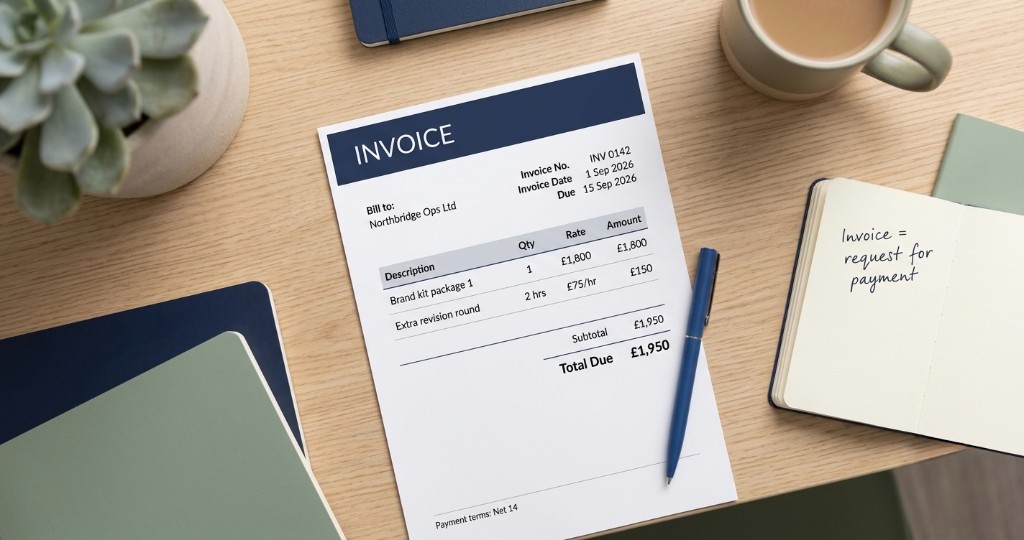
Short answer: an invoice is what you send when you want to get paid, either for finished work or for a deposit. It’s the document the client’s finance team logs and pays from, so if it’s clear and complete, the money tends to arrive on time.
An invoice is just a formal way of saying “here’s what you owe me, and here’s how to pay.” More precisely, an invoice is a document you send a client to request payment for goods or services. It states who’s billing, who owes the money, what was provided, how much is due, when it should be paid, and how to pay.
It isn’t a friendly reminder and it isn’t a rough quote. It’s the formal request that gets logged by the client’s finance team and starts the payment clock.
Why invoices matter
For freelancers and small businesses, a good invoice does the following tasks:
- Conveys all the detials the client needs to pay so its finance teams can process it
- Creates a record for your books, taxes, and any disputes
- Sets expectations on timing (due date) and the method of payment (bank, card, etc.)
Without an invoice money might still come in but its possible that arrives late and is often messier. If there is a problem it becomes much harder to prove what went wrong.
A quick worked example
Jordan finishes a brand kit for Northbridge Ops Ltd. He sends invoice INV 0142 dated 1 September, due 15 September (Net 14), with two line items, VAT where required, bank details, and a Pay button. The client’s finance team can process it without emailing “what is this for?”
Invoice vs estimate vs bill vs receipt
These documents get mixed up often:
| Document | Purpose | When you send it |
|---|---|---|
| Estimate (quote) | Propose price and scope | Before work is agreed |
| Invoice | Request payment, usually with terms such as Net 14 | When money is owed |
| Bill | Request immediate payment, like a restaurant or utility bill | At the point of sale |
| Receipt | Confirm payment received | After the client has paid |
In practice, “invoice” and “bill” are often used interchangeably. The difference is mostly perspective: you send an invoice, and your client records it as a bill to pay.
Use an estimate while the work is still negotiable, and an invoice once payment is due. We unpack that split in invoice vs estimate. For the estimate definition itself, see what is an estimate.
Common types of invoices
Honestly, most freelancers only ever need three of these: standard, deposit, and recurring. The rest are worth knowing so you’re not caught off guard when a client asks for one.
Standard (final) invoice
Completed work or an agreed milestone. This is what most people mean by “invoice”: the remaining balance after any deposits, with a real due date and clear payment methods. Use it when scope is settled and money is owed now.
Deposit or advance invoice
Part payment before or at kickoff. It must still look like a real invoice, with a unique identifiable number, amount recquired, due date, and what the deposit covers. If refunds apply on certain items and/or in specific cases, say so on the document rather than in a text or chat message nobody will find later.
Progress or milestone invoice
Billed against stages (for example 40% then 30% then 30%). Name the stage that just finished so finance can match it to the PO or statement of work. Milestone billing collects money at each milestone, and that money helps fund the upcoming ones, so you’re not carrying the entire project until the last delivery day.
Recurring invoice
Same structure on a schedule (retainers, subscriptions). Each cycle still gets a new invoice number, a fresh date, and a period line such as “September 2026 retainer.” See recurring invoices explained.
Proforma invoice
Often a preliminary bill for customs or advance planning. Clients sometimes ask for one just to get budget approval internally. It isn’t always a payment demand the way a standard invoice is, so clarify whether they expect a payable invoice next. Don’t treat a proforma as proof that cash is already due unless both sides agree it is.
Credit note (related document)
When you need to reduce or cancel a billed amount, issue a credit note rather than quietly editing the original. The original number stays in history and the credit references it. Ask your advisor how credits should appear in your local books.
Other types you may come across
| Type | What it is for |
|---|---|
| Timesheet invoice | Billing hours worked, with a breakdown of time per task. Common for freelancers and consultants |
| Retainer invoice | Securing your availability or services up front with a payment before work starts |
| Debit note | Increasing the amount a client owes, for example for extra work or a correction |
| Past due invoice | A follow up sent after the due date passes, sometimes with an agreed late fee |
| Commercial invoice | Accompanies international shipments so customs can assess duties and taxes |
What an invoice includes
Required fields
A solid invoice carries:
- Seller identity (name, address, contact)
- Buyer identity
- Unique invoice number and invoice date (see invoice numbering)
- Due date or payment terms
- Line items with descriptions and amounts
- Tax where applicable
- Grand total and currency
- Payment instructions
Optional fields that prevent delay
- Purchase order number
- Project or job reference
- Late fee note (agreed up front)
- Tax registration numbers where required locally
Presentation matters too. Clients pay faster when the document is easy to scan. See what makes a professional invoice.
Sample invoice field walkthrough
Here’s a labelled walkthrough of a simple freelance invoice so you can see how the fields work together.
Header block
- From: Jordan Lee Trading as Brightline Studio, address, email
- Bill to: Northbridge Ops Ltd, accounts payable email
- Invoice number: INV 0142
- Invoice date: 1 September 2026
- Due date: 15 September 2026 (Net 14)
- PO number: PO 8891
The header answers who, whom, which document, and when, so finance can file it without reading the body first.
Line items
| Description | Qty | Rate | Amount |
|---|---|---|---|
| Brand kit package (logo, colours, type) | 1 | £1,800 | £1,800 |
| Extra revision round beyond estimate | 2 hrs | £75/hr | £150 |
Descriptions map to the approved estimate. Hours and rates are explicit so nobody has to reverse engineer the total.
Totals and tax
- Subtotal: £1,950
- Tax (example VAT line where required): as applicable locally
- Grand total: printed in the agreed currency
If tax doesn’t apply, say so or leave the tax line at zero rather than leaving the client to wonder whether you forgot.
Payment block
- Bank transfer details on the PDF
- Pay link from a payment gateway such as Stripe
- Any other method you accept, such as PayPal or Wise
- Note: “Please quote INV 0142 on the transfer reference.”
That last line is how remittances get matched without any follow up emails.
Why the walkthrough matters
Every field above exists to answer a question finance will ask. If you skip the PO, they stall. If you skip the due date, they invent one. If you skip payment details, they reply asking for them. It helps to write the invoice as if someone who has never heard of you will be the one processing it, because often they will.
Digital vs paper invoices
Most freelancers now send digital invoices like PDF attachments, shareable links, or portal uploads. Paper still turns up in some industries and regions, but the job is the same.
Digital advantages
- Instant delivery and easy resends
- Links that can show viewed or paid status
- Pay links (for example Stripe) so clients pay straight from the invoice
- Searchable history for tax time
- Lower printing and postage cost
When paper still appears
Some clients or customs processes still want a printed copy. If you have to post paper, keep the digital original as the source of truth and use the same invoice number on both. Don’t create a second, conflicting number for the printed version.
E-invoicing
E-invoicing is not the same as emailing a PDF. E-invoicing means sending the invoice as structured data that the client’s accounting system and sometimes the tax authority can read automatically. Parts of the EU already require E-invoicing, for businesses and more countries are following. If you sell to companies or governments make sure to check if they require a format or a specific portal before you send your first invoice. It’s always good to check these details upfront to avoid delays.
Practical digital habits
If you are not sure which way the client prefers send the PDF and the link together. Keep the sent PDF (or app record) so you can prove what went out. Avoid editing the PDF after the client has filed it and issue a corrected invoice with a number if the change is material. A portal upload counts as “sent” only once you have confirmed that the portal accepted the PDF so note the upload date.
Security and professionalism
Use a clear filename like INV-0142-Brightline.pdf. Don’t rely on screenshots of a spreadsheet as your only record. The same required fields apply whether the invoice is printed or digital.
If a client asks for something different, like a merged statement or a smaller file, a browser tool such as LocalPDF.me can split, merge, or compress the PDF locally, so the document never leaves your machine.
Who uses invoices?
Anyone who sells and needs a clear payment request: freelancers, contractors, agencies, shops, and service businesses. If you’re on payroll, you usually don’t invoice your employer. If you’re self employed or run a limited company that bills clients, you do.
Tax labels and required fields differ by country. Some regions expect VAT or GST numbers, others want specific sole trader wording. This article is educational, not tax advice, so confirm local rules before you lock in your defaults.
How to create one
You can make an invoice with a Word or Excel template, a free browser invoice maker for a one off trial, or an invoice app like Trueinvoice that stores clients, history, and status. The hands on walkthrough lives in how to make an invoice. For the Trueinvoice app flow, follow Create an invoice.
FAQ
What is the difference between an invoice and an estimate?
An estimate proposes work and price before payment is owed. An invoice is a formal request for payment after terms are agreed or work is done.
Is an invoice a legally binding contract?
An invoice is a payment request, not a substitute for a contract. It is, however, strong evidence of a debt, especially when linked to an approved estimate or written agreement.
What should every invoice include?
Your details, the client’s details, a unique invoice number and date, a due date, clear line items, tax where required, a grand total, and how to pay.
Do freelancers need to send invoices?
Yes, if you want a clear paper trail and reliable payment. Informal ‘just transfer me’ requests create confusion and make tax time harder.
Can I invoice without a registered company?
Often yes as a sole trader or self employed person, using your legal name. Rules vary by country. Confirm local requirements for tax IDs and business registration.