Article
How to invoice as a freelance designer or photographer
Invoicing for designers and photographers, covering deposits, revision limits, kill fees, usage rights, and clear line items, with worked examples to copy.
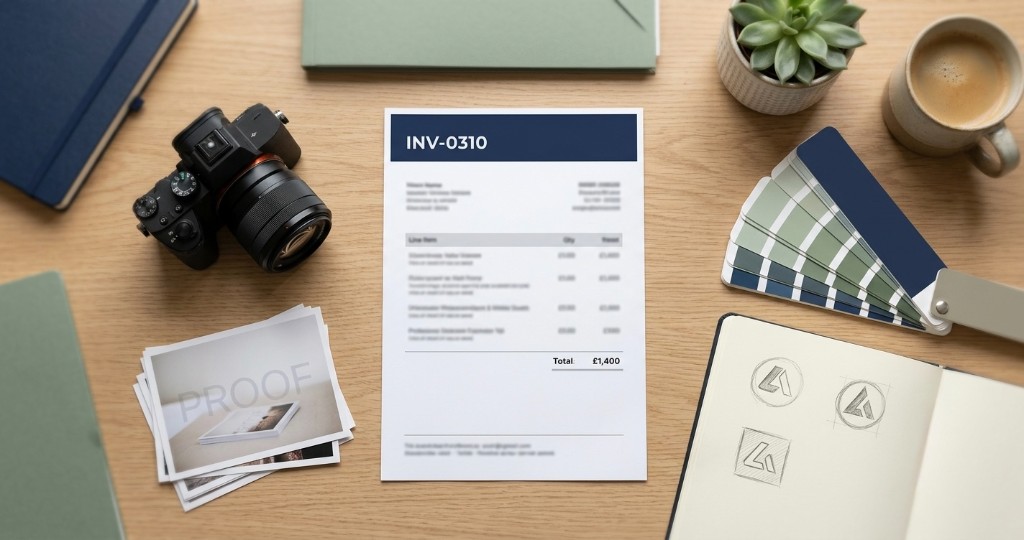
Short answer: agree the deliverables, revision rounds and usage rights in an estimate before you start. Take a deposit of 30 to 50% to hold the date or begin the project, bill the rest at milestones, and put anything extra, like more revisions or wider usage, on its own clearly named line. Name what the client is getting on every invoice, not just “design work.”
Creative projects rarely go in a straight line. Concepts change, feedback arrives in pieces, and a shoot booked for March can move to May. Your invoices have to keep up with all of that and still make sense to a finance team that never saw the brief. That means being specific about what’s included, when money is due, and what the client is allowed to do with your work.
This builds on how to make an invoice and invoice vs estimate. If you also do advisory work, see how to invoice as a consultant.
What a creative invoice needs to make clear
A client should be able to read your invoice and know three things without emailing you. First, exactly what they’re paying for: the package, the number of concepts or images, the revision rounds, and the file formats. Second, where this invoice sits in the project, whether that’s the deposit, a milestone, or the final balance. Third, what rights come with the work, if usage matters.
“Design work, £2,000” answers none of those. “Brand identity package: 3 logo concepts, 2 revision rounds, final files in SVG, PNG and PDF” answers all three.
Start with an estimate
Send an estimate while the concepts, shoot length or number of revisions are still being discussed. It’s where you agree the details before any money changes hands, and once the client approves it your invoices can follow its structure. If you’re new to this, what is an estimate explains how it differs from an invoice.
Say Maya, a brand designer, is quoting a new café for a logo and menu design. Her estimate spells out three logo concepts, two rounds of revisions, and final files in SVG, PNG and PDF, delivered within four weeks of the deposit. It also says what she isn’t doing: printing the menus, buying stock photos, or turning things round in a rush. When the owner later asks her to “just sort the printing,” she can point to that line instead of absorbing the job.
A photographer’s estimate covers different ground. For a half day product shoot, that means the date and start time, how many edited images the client gets, how much retouching is included, any studio or travel costs, and where the photos can be used. “Web and social only” and “web, social and print” are very different jobs, and they should be priced that way.
Deposits and milestones
Most design projects split neatly into three payments. Maya takes 40% before she starts sketching, 30% when the café picks a concept, and the final 30% when she hands over the files. Each invoice lands right after the client has seen progress, which is when they’re happiest to pay it.
Photo shoots work differently, because you’re not just taking pictures, you’re also selling the date, or a few hours of it. A booking deposit holds it, and the balance is due before or on the day. If the client comes back a month later wanting ten more edited images or permission to use a photo on a billboard, that’s a new invoice, not an adjustment to the old one.
Write your pause policy into the estimate: if a milestone invoice isn’t paid, work stops until it is. It’s much easier to point to that line than to bring it up for the first time when a payment is late. Before you pause anything, a couple of polite payment reminders usually does the job, and in Trueinvoice you can automate them.
Setting a revision policy
“One more small tweak” is how creative projects turn into unpaid work. A written revision policy stops that before it starts. It should say how many rounds are included, what counts as a round (one set of combined feedback, not a stream of separate comments), what extra rounds cost, and where the line sits between a revision and new work, like an extra page or another set of shots.
Here’s a clause you can adapt:
The package includes two revision rounds. Please send feedback for each round in one combined note within five working days. Extra rounds are charged at £75 per hour, or a flat fee quoted before work continues. New deliverables outside this estimate need an updated estimate.
Put the included rounds on the deposit invoice too, so the client and their finance team see the same limit. When you do bill an extra round, give it its own line, such as “Additional revision round beyond package, 3 hours at £75/hr,” rather than hiding it in a general design fee.
Kill fees and cancellations
Tom, a product photographer, books a £1,500 photo shoot for a skincare brand on a Thursday and takes a £600 deposit. He turns down two other enquiries for that day. Four days before the shoot, the brand cancels because their samples haven’t arrived.
Because his estimate said the deposit is kept if a shoot is cancelled within seven days, Tom keeps the £600 and there’s no argument. Without that line, he’d be out a day’s work and negotiating a refund with a client who feels it wasn’t their fault. Some photographers go further and charge a kill fee, a percentage of the remaining balance, for very late cancellations. Either way, decide it up front, and say whether the deposit carries over if the client reschedules instead of cancelling.
Tom’s estimate uses wording like this:
A 40% booking deposit holds the date and is deducted from the final balance. If the shoot is cancelled within 7 days, the deposit is kept as a cancellation fee. Reschedules requested within that window may carry a fee if the original date can’t be rebooked.
Agree this in writing before any money moves. Invoicing a kill fee after a vague phone call is far harder than pointing to an approved estimate.
Get sign off before the final invoice
A final invoice shouldn’t be the first time a client sees an extra charge. Before you send it, deliver the near final files or gallery with a short summary of what’s in scope, ask for combined feedback or written approval, and quote any out of scope work before you start it. Only then send the final invoice, and release the full resolution files according to your payment policy. Many photographers and designers send watermarked or low resolution proofs until the last invoice is paid.
An email that says “approved, and the extra round quoted at £150 is fine” is your paper trail if finance ever questions a line. If the client goes quiet, send one short note saying the final invoice will cover the agreed package only, then bill what was agreed.
Line items clients understand
| Weak | Stronger |
|---|---|
| Design | Brand logo package, 3 concepts and 2 revision rounds |
| Website | Homepage and 3 inner page designs, as per EST-0018 |
| Photos | Half day product shoot, 20 edited images, web usage |
| Extra | Additional revision round beyond package, 2 hours at £75/hr |
If usage is part of the fee, add a note like this:
Usage included: digital and social use in the client’s own channels for 12 months. Print, paid advertising or exclusive use can be licensed separately.
Payment terms for creative work
Net 7 or Net 14 suits most creative freelancers. For shoots and events, the balance is often due on receipt or on the day. Larger brand clients may ask for Net 30, and that’s the time to insist on a booking deposit. There’s more on choosing terms in payment terms on invoices.
Put your payment details on every invoice. If you use Trueinvoice and connect Stripe, the invoice PDF gets a Pay button, and so does the web version of the invoice your client opens from a shared link, a QR code, or the email you send from the app. Either way, they can settle the balance online on the day of the shoot instead of waiting for a bank transfer. See connect Stripe and get paid.
Worked example: a photographer
- You send estimate EST-0077 for a half day product shoot: 25 edited images, web usage, £1,200.
- The client approves, and you send INV-0301 for the 40% booking deposit of £480, due in 7 days.
- You send INV-0302 for the £720 balance, due on the shoot day.
- A month later the client wants to use three images in a print catalogue, so you send INV-0303 for the extra print licence.
Worked example: a designer
- You send estimate EST-0088 for a brand kit at £3,500, with two revision rounds included.
- On approval, you send INV-0310 for the £1,400 deposit.
- When the client picks a concept, you send INV-0311 for £1,050.
- On delivery of the final file package, you send INV-0312 for the last £1,050.
In Trueinvoice, you can convert the approved estimate into an invoice so the client and line items carry across, then edit the draft down to the deposit or milestone amount before you send it.
Common creative invoicing mistakes
The costly ones are starting a shoot or concepts with no deposit, and sending final files before the last invoice clears when your policy says otherwise. Vague lines like “design services” slow payment down. So does forgetting to rebill print, props or travel costs you paid for (a simple expense tracking habit catches those), and starting work with no estimate while the scope is still fuzzy. For the mistakes that trip up every kind of freelancer, see common invoice mistakes.
Where to go next
- How to send an invoice
- What makes a professional invoice
- Create an invoice
- Create an estimate and convert
FAQ
Should designers take a deposit before starting?
Yes, especially with new clients or bigger projects. A deposit of 30 to 50% before kickoff covers your early time, confirms the client is serious, and protects you if the project is cancelled.
How do photographers invoice for a shoot?
Most take a booking deposit to hold the date, then invoice the balance before or on the shoot day. Extra edits, more images, or wider usage go on a separate invoice later, each as its own clearly described line.
Do I need to mention usage rights on the invoice?
If the fee includes a licence, yes. State what use is covered, where, and for how long, or refer to the contract that does. Unclear rights cause disputes even when the fee itself is agreed.
How should I charge for extra revisions?
Set the number of included rounds in the estimate, then bill anything beyond that at an hourly rate or a quoted flat fee. Put it on the invoice as its own line, like ‘Additional revision round, 3 hours at £75/hr’, so the client can see exactly what it’s for.
Should I send an estimate or an invoice first for creative work?
Send an estimate first while the concepts, shoot length or revision rounds are still being agreed. Invoice once a deposit or milestone is due.