Article
How to invoice as a consultant: deposits, day rates and examples
How freelance consultants should invoice, from estimates and deposits to day rates, milestone billing, line items finance teams approve, and a worked example.
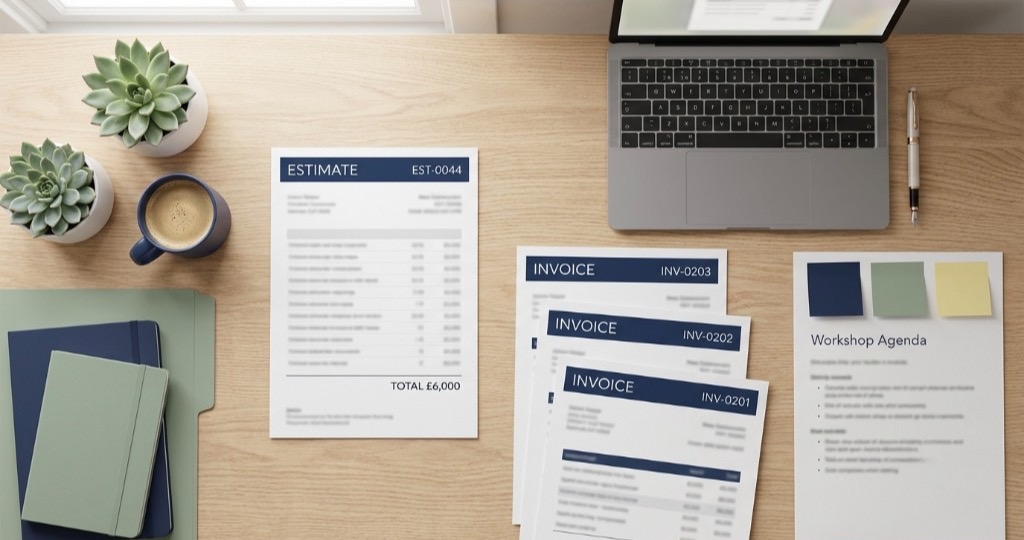
Short answer: agree the scope and fee in an estimate first, take a deposit before you start, and bill the rest at milestones rather than in one lump at the end. On each invoice, name the engagement, the period, and the deliverable in the same words the client used in their proposal or purchase order. Use Net 14 terms where you can, and a clear calendar due date every time.
Consultants sell advice, workshops and analysis, which makes their invoices harder for a finance team to process than a bill for a product. A line saying “Consulting, £4,500” doesn’t tell anyone what was delivered or which budget it comes from, so it sits in a queue while someone emails you to ask. The fix is structure: an estimate up front, a payment plan that matches the work, and line items that mirror the paperwork the client already approved.
For the basics of building an invoice, start with how to make an invoice. For choosing terms, see payment terms on invoices.
What a consulting invoice has to prove
A finance team checking your invoice is asking three questions. Does this match what we agreed? What period or milestone does it cover? And is it obvious how and when to pay?
So every line should map to something in the approved proposal. Retainers need a clear period, like “October 2026 advisory retainer.” And the due date, currency, tax and payment details should all be on the invoice itself, so nobody has to email you to ask.
Start every engagement with an estimate
New consulting work is almost always negotiable, and the scope often shifts in the first conversation. An estimate pins down what’s included, what isn’t, and how you’ll bill before any work starts. Once the client approves it, your invoices can follow its structure exactly. If you’re unsure of the difference, read what is an estimate and invoice vs estimate.
Here’s a scope block you can adapt:
Scope: up to six stakeholder interviews, a half day process mapping workshop, and a written recommendations memo.
Excludes: implementation, software licences, and travel outside London.
Fee: £6,000 fixed, billed 40% on approval, 30% after the workshop, and 30% on delivery of the memo.
Valid for: 14 days.
The exclusions line matters as much as the scope. It’s what lets you say “that’s outside what we agreed” without an awkward conversation later.
Choosing how to bill
There’s no single right model. The best one depends on how clear the work is at the start.
| Model | How you bill | Works best for | Watch out for |
|---|---|---|---|
| Day rate | Days or half days × your rate | Discovery, workshops, open ended advisory | Scope creep without a cap on days |
| Hourly | Hours × your rate | Short bursts of advice | Admin time you forget to log |
| Fixed fee | One agreed price for set deliverables | Audits, strategy memos, defined projects | Extra requests after the price is agreed |
| Hybrid | Fixed discovery, then day rate or milestones | Unclear starts that get clearer later | You must spell out the switch in the estimate |
Whichever you choose, the invoice still needs context. “3 days at £900” is weaker than “Pricing workshop and synthesis, 3 days at £900, 8 to 10 October 2026.”
Deposits, milestones and retainers
Take Sam, an operations consultant who wins that £6,000 process project. Before booking a single interview, Sam invoices £2,400, which is 40% of the fee. That covers the first three weeks of calls and prep, and a client who pays it quickly is a client who’s serious. After the workshop in week four, Sam bills £1,800. The last £1,800 goes out the day the memo lands. If Sam had waited to bill the whole £6,000 at the end, the project would have run for two months on Sam’s own money, with every chance the final invoice sat in a finance queue for another month on top.
For ongoing advice, a monthly retainer invoiced at the start of each month works well. A recurring invoice sends it on the same day every month, so you’re not relying on memory. If a large client insists on Net 30, invoice the first month before you start, so you’re never more than one month exposed.
Line items that get approved
The quickest way to speed up payment is to make each line self explanatory.
| Weak | Stronger |
|---|---|
| Consulting | Q4 pricing strategy, phase 1 discovery |
| Services | Half day workshop facilitation, 10 October 2026 |
| Hours | Advisory calls, 8 hours at £150/hr, week of 5 October |
| Retainer | Monthly operations retainer, October 2026 |
If the client gave you a purchase order or statement of work with numbered deliverables, copy their wording. Finance teams match documents by the words as much as the numbers, so if their paperwork says “Stakeholder interview pack,” your invoice should too. Put the PO number somewhere prominent, near the invoice number or in the notes, because many large companies won’t pay an invoice without one.
Passing on expenses
Approved third party costs, like venue hire or printing, should be separate lines rather than folded into your fee. It keeps your rate clean and makes the costs easy to check.
Here’s how the midpoint invoice from the scope block above might look, as INV-0202:
| Line | Amount |
|---|---|
| Process mapping workshop facilitation (milestone 2 of 3) | £1,800 |
| Venue hire, rebilled at cost (receipt attached) | £420 |
| Printed workbooks × 12, rebilled at cost | £96 |
| Total | £2,316 |
Add a short note such as: “Venue and printing costs match the budget approved in EST-0044 and are rebilled at cost with no markup.” If your contract allows a handling fee, state it on the invoice so it doesn’t look like a surprise. Keep the receipts with the invoice, so a query takes a minute to answer. If costs like these tend to slip through the cracks, how to track expenses as a freelancer shows a simple way to log them so none get missed.
Payment terms that protect you
Net 14 is a good default for smaller clients, and Net 7 works well for short engagements. If a corporate client needs Net 30 or longer, don’t carry all the risk yourself. Take a deposit and bill milestones, so a slow payment on one invoice doesn’t leave you months out of pocket. Always show an actual calendar due date, not just “Net 30.”
Make paying easy, too. Put your bank details on every invoice. If you use Trueinvoice and connect Stripe, the PDF gets a Pay button, and so does the web version of the invoice your client opens from a shared link or the email you send from the app. Either way, they can pay online in a couple of taps. See connect Stripe and get paid.
A worked example, start to finish
Here’s how the £6,000 strategy project from the scope block runs:
- You send estimate EST-0044 for £6,000, split 40/30/30.
- The client approves it by email, and you send invoice INV-0201 for the £2,400 deposit, due in 7 days.
- After the workshop, you send INV-0202 for £1,800, plus the £516 of approved expenses, a total of £2,316.
- When you deliver the memo, you send INV-0203 for the final £1,800.
- Each week, you check what’s outstanding as part of your cash flow routine, and reminders handle any follow up.
In Trueinvoice, you can convert the approved estimate into an invoice so the client and line items carry across, then edit the draft down to the deposit amount before you send it. And automatic reminders can email the client on the due date and again if it runs late.
Common consulting invoicing mistakes
Most problems come from the same few habits. The worst is starting work for a new client with no deposit, which leaves you funding their project. Close behind are vague single lines like “Consulting services,” waiting until the final report to bill anything, and leaving off the PO number when the client’s process needs one. Mixing estimate wording like “valid for 14 days” into an invoice also confuses finance teams, so keep the two documents separate. For the mistakes every kind of freelancer makes, see common invoice mistakes.
Where to go next
- How to make an invoice
- How to send an invoice
- How to set up and send payment reminders
- How to invoice as a freelance designer or photographer
FAQ
Should consultants charge hourly, a day rate, or a fixed fee?
A fixed fee works best when the deliverable is clear, like an audit or a strategy memo. Day rates suit open ended discovery and workshops. Many consultants combine the two: a fixed discovery phase, then a day rate or milestones once the scope is clearer.
Should a consultant send an estimate before invoicing?
Yes, for any new engagement. An estimate agrees the scope, exclusions and fee before work starts, and every invoice afterwards can point back to it.
How much deposit should a consultant ask for?
A 30 to 50% deposit on approval is common for project work, with the rest billed at milestones. For retainers, invoice at the start of each month rather than the end.
What payment terms should consultants use?
Net 14 is a sensible default for small clients. Large companies often insist on Net 30 or longer, so protect yourself with a deposit and milestone invoices rather than one big bill at the end.
What should a consulting invoice say?
Name the engagement, the period or milestone, and the deliverable, and use the same wording as the proposal or purchase order. A single line saying ‘Consulting services’ is the fastest way to get an invoice queried.